
This interview is taken from MAKERS Zine #3 — get all future copies of MAKERS by signing up as a Patron today! You can also buy a copy of MAKERS #3 in our shop.
Ella, Emily and Katie are Eek & Wild: a dance company specialising in collaborative performance with children and families.
As Artists in Residence at Chelsea and Westminster Hospital, the trio bring joy, thoughtfulness, and constant innovation into their work.
Their latest project drew on the hospital environment itself and the large artworks that live there; they applied to Sputnik for a grant to add deeper preparation to the show.
We talked to them all about the challenges and inspirations of their work.
Hi everyone! To start, what do you love about your work? What draws you into a project?
We love that our work helps to bring joy, surprise and delight to children and their families in an otherwise difficult situation. It’s a huge privilege to be able to bring something a little bit different to people coming into hospital. We also love the creative, playful element of our work – spending time together creating movement to help bring things to life is so much fun.
How did the idea and the inspiration for ‘SCULPT’ come about?
As Artists in Residence at Chelsea and Westminster Hospital, we were already dancing on the Paediatric wards with Pick ‘n’ Mix, our pop-up performances for bedsides, bays and waiting rooms. However, we felt we wanted to try out something fresh to keep our creative practice alive.
We thought that making something for the public atrium in the hospital would work well as the footfall is so high, and it would allow staff, patients and visitors to enjoy something different. Chelsea and Westminster Hospital have a large artwork collection and we are interested in combining different art forms.
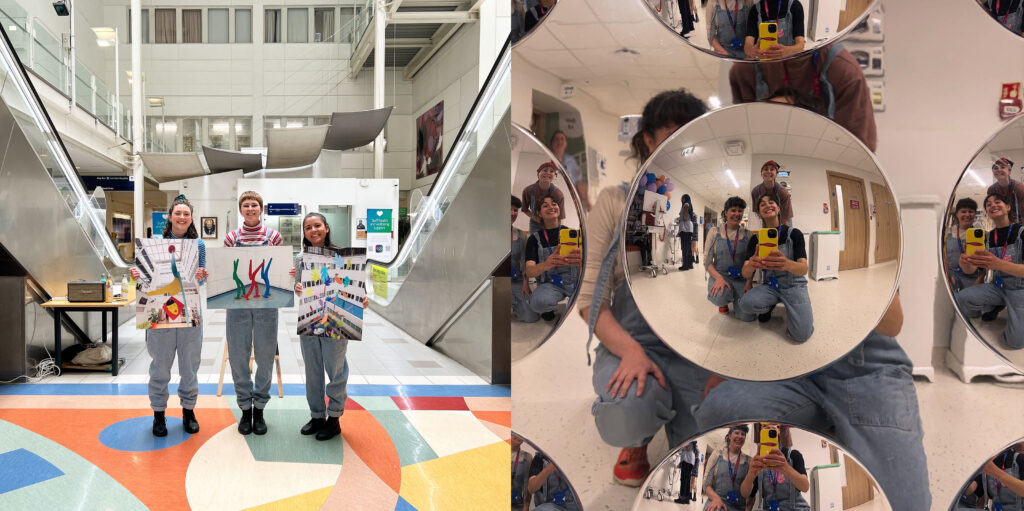
The idea of a “living gallery” excited us and we thought it would help to bring the art to the forefront rather than just on the walls. As we spent time looking at the art collection, we realised it was the sculptures that caught our attention the most and lended themselves to creating movement. Thus, the idea for SCULPT was born!
Is there something about dance that lends itself to this very interactive creation process? Does that make things easier, or is there a different kind of challenge to it?
Dance naturally lends itself to an interactive and collaborative creation process because movement is something everyone can connect with; it’s innate, and children especially love to move and express themselves physically, even when they have limitations.
One of the great things about working with children is that they see the world differently from adults. When ideas come from them, we know we’re incorporating things that genuinely make sense to them and spark their interest. The research and development process in dance is also very fluid and non-linear, which means co-creation fits really well with how dance naturally evolves.
“One of the great things about working with children is that they see the world differently from adults.”
However, there are also challenges. It’s important to make sure the ideas truly come from the children, rather than us unintentionally influencing them. And because some children are in bed or have restricted movement, we often need to find creative ways to translate their gestures and suggestions into movements that can be performed by our own bodies.
Tell me about the performance experience with ‘SCULPT’. What kind of reactions did you get?
Performing in a hospital is always unpredictable and it’s important to remember that you aren’t the main event. We wondered if people would stop and watch as it’s a busy space where people are rushing off to appointments or to see loved ones but the performance experience was great!
The show drummed up a crowd and people were very interested in what was going on. It seemed to bring lots of joy, and people were stopping with big smiles on their faces. The hospital has multiple stories – we were performing on the ground floor, and it was fun to look up and see hospital staff watching from the floors above.
Something central to Eek & Wild’s work is choice, which was important to us to bring into SCULPT. The audience were able to choose which dance to watch when. We were pleased that this choice-based practice worked well in a public setting just as well as it does on the wards.
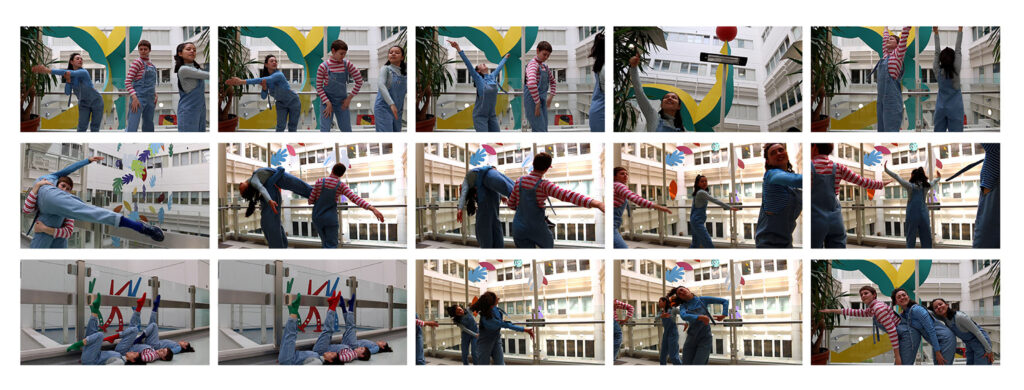
A memorable moment was a quote from an older gentleman. We weren’t sure whether he was enjoying it or not, but at the end of the performance he told us that it was like the Wedding at Cana because we had saved the best dance till last! The last dance we performed that day was based on the sculpture “Walking”. This is quite a cheeky dance-—all the choreography is just with our legs and set to the Can-Can music. We were delighted that it had connected with this older gentleman.
What difference did it make to have a grant from Sputnik?
We didn’t have any funding for this project beyond the paid time we have in the hospital for our regular sessions. We were able to start creating the show during those ward visits, but we had no budget for things like costumes, props or any extra rehearsal time—the details that really help bring a piece to life.
The Sputnik grant made all the difference. It allowed us an extra full day rehearsing together in a studio to polish the work, to buy costumes and have images of the sculptures printed onto large boards which completely transformed the look and feel of the performance.
“The experience really shaped how we think about our performances now: finding creative ways to connect people with their surroundings.”
Beyond the practical support it also meant a lot to feel seen, to know that someone believed in what we were doing and recognised its value. As a small company we often work quite independently and can sometimes question whether our work is being noticed or taken seriously. Receiving the grant was a real boost; it reminded us that what we’re creating is relevant, good quality and worth investing in. We’re so grateful, it gave the project not just resources but a real sense of validation and encouragement. Thank you!
What has happened since ‘SCULPT’? Are there ways that the experience has shaped newer projects?
Yes! SCULPT was such a success that we went on to repeat a very similar process at a different hospital. We created The sculptures that couldn’t keep still for children at Milton Keynes Hospital, inspired by the sculptures in their own art collection. It’s been amazing to bring more sculptures to life, and to see how the children respond with such curiosity and joy.
We love that this kind of work doesn’t just engage the young patients; it also helps to shine a light on the incredible artwork that already exists within the hospital but often goes unnoticed. The experience of SCULPT really shaped how we think about our performances now: finding creative ways to connect people with their surroundings and to transform familiar spaces into something playful and alive.
Next up we’re taking some time to apply for Arts Council funding, to create a new piece of work that places patients with complex neuro-diverse and physical support needs at the centre. We want to create a new show specifically for this patient group that is immersive, sensory and fully transforms clinical settings.
What are the biggest challenges in your industry at the moment, as performers?
The industry has always been competitive, but it feels tougher than ever at the moment. There are fewer jobs to apply for, less funding available and a real sense that you’re constantly having to prove your worth. As a small company we spend a lot of time doing unpaid admin; writing applications, organising logistics or chasing opportunities. It can sometimes feel overwhelming before we even get to the creative part.
On a more personal level, one of the biggest challenges is managing comparison. With social media it’s so easy to feel like everyone else is more successful than you are. There’s also the ongoing process of separating your identity and self-worth from your work; learning not to take rejection personally, and remembering that being a dancer is a part of who we are but it isn’t everything.
What would you want to tell people about running a dance company that they might not realise, or would surprise them?
We’ve already mentioned this, but we think people would be surprised by just how much time we spend behind a laptop. There’s this idea that running a dance company is all about being in the studio or on stage, but in reality a huge part of it is admin—writing proposals, applying for funding, scheduling rehearsals, emailing venues, sorting logistics, etc! It takes a lot of invisible work just to make one performance happen.
“We’ve learned to adapt. We can perform pretty much anywhere.”
Time and space are two things we’re always fighting for. We need time to research and develop new choreography and we need space to make it, which sounds simple, but finding an affordable studio or even somewhere to warm up before performing can be a real challenge. When we perform in hospitals for instance, we’re often hunting for a corridor or a corner that’s big enough to swing an arm without disturbing any staff, patients or equipment!
But the flip side is that we’ve learned to adapt. We can perform pretty much anywhere. Whether it’s a tiny room, a bedside or a corridor surrounded by medical machinery we make it work. There’s something quite beautiful about that flexibility, bringing dance into unexpected spaces and making it fit around real life.
Lastly, does being an artist give you a particular perspective on faith? What do artists bring to the church?
Contemporary dance is all about exploring ideas and posing questions rather than providing answers. There’s no right or wrong way to interpret what you see. Artists are trained to notice, provoke, explore and to play. That way of noticing and questioning naturally feeds into how we experience faith. Just as dance invites multiple interpretations, faith invites reflection and dialogue. We think being an artist helps you hold space for mystery, uncertainty, and wonder; qualities that are at the heart of spirituality.
Artists are also able to find inspiration in things others might miss. In Christian contexts there’s often a focus on the big picture or the main message, but this attention to nuance and the overlooked can open up fresh insights and invite deeper exploration.
Being a dancer also brings you close to your colleagues in a really unique way. There’s a huge amount of trust, empathy and love that develops when you work physically and creatively together; a kind of human connection that can feel very profound. We think that sensitivity, openness and relational depth are some of the things artists bring to the church.
Find Eek & Wild at eekandwild.com
Ella, Emily and Katie were speaking to Sputnik’s Art Director, Chris Donald (@chris.makes.things)


