
This interview is taken from MAKERS Zine #2 — get all future copies of MAKERS by signing up as a Patron today! You can also buy a copy of MAKERS #2 in our shop.
Caner Mutu is a filmmaker and photographer living in Hastings.
His work puts empathy front and centre, using his art as a way to discover the world, and make deep friendships with people around him.
In 2025, Caner began gathering stories of local asylum seekers in his home town, and taking photographs for a project he came to call SEED-TIMES. Sputnik gave him a grant to help turn the project into a full-fledged exhibition. We spoke to Caner about his process, his faith, and the big event.
Hi, Caner. To start, what do you love about your work? What draws you into a project?
I love the whole creative process. I try to immerse myself as much as possible in what I’m curious about at the time. Whether it’s going to a gallery or being in the garden – I’ll be finding ways to explore and play about with an idea, usually before realising it’s even a project. Having multiple projects going at once is quite common for me.
I think that a big catalyst for creativity is meeting new people. My last project focused lots around community and diversity, and I had the chance to meet some incredibly warm and unique individuals. I find I work best and feel most inspired when I’m surrounded by people who I can bounce ideas off and who give me honest feedback. It’s amazing how just a short conversation can help take an idea to the next level.
How did the idea for ‘Seed Times’ come about?
I discovered that the famous Victorian botanical painter and explorer Marianne North came from my hometown, Hastings. She loved to travel and create vibrant floral pieces on canvas; and she often held picnics, inviting people from different backgrounds and ethnicities to eat together in her garden. As well as being controversial for her time, I was intrigued by how her work brought people together and shared richness from around the world. Her celebration of nature and diversity reminded me of our connection to the natural world and to each other.
Around this time, I was reading lots of books (including cookbooks and gardening books), but a verse from Genesis 8:22 had stuck with me:
“As long as the earth endures;
Seedtime and harvest
Cold and heat
Summer and winter
Day and night
Will never cease.”
As I read this, I pondered the current cultural, political, and spiritual state of our world. According to Genesis, we are in the age of ‘seedtime and harvest’ because the earth continues to exist. This, to me, speaks of hope and abundance, that we’re all equal, made to be fruitful and flourish.
A BBC documentary called The Private Life of Plants helped me to take this idea further when a scene depicted a field of dandelion heads catching the wind, forming a cloud-like hypnotic dance.
“This project has helped me process and understand a lot more things than I expected.”
The narrator explained that ‘every generation must make room for the next,’ and this connected the dots in my mind. Inspired, I went down some more rabbit holes – exploring migratory bird patterns in my area, studying permaculture gardening, learning about some of the many complicated and confusing UK immigration laws, and even taking apart a microscope in my kitchen to photograph various found seeds. Safe to say, I was in deep, but having lots of fun.
Did the project prompt you to think about your own relationship to place, and nature, differently?
I went into this thinking I would very much be done in two to three months. It turns out I spent 18 months developing the idea, and still feel I’m scraping the surface.
This project has helped me process and understand a lot more than I expected, like knowing how some people in my community have felt, or do still feel. Hearing something of their experience has given me not only perspective but connections with real families. Being centred around nature meant I had to be outside and look for those connections through the lens, and this in and of itself was massively powerful — dare I say, spiritual.
To process stories of being displaced whilst photographing a fragile flowerhead; or recalling how strong and happy a family now are, living in a loving community, whilst filming a starling murmuration over the sea; these things led me to appreciate the community God has placed me in, and to try to love others better. My love for my town and its people has increased massively, as has my wonder in creation.
Through this project, I teamed up with the ‘Refugee Buddy Project’, a local charity that supports and advocates for safe refuge in Hastings. We ended up co-exhibiting together alongside their ‘Safe Havens’ project. This connection was perfect, as it helped ground my work to a meaningful local initiative. The cherry on top was that we were able to exhibit during Refugee Week, so we had people popping in throughout the installation getting sneak peeks and asking about the project.
Tell me more about that exhibition experience. How did it go?
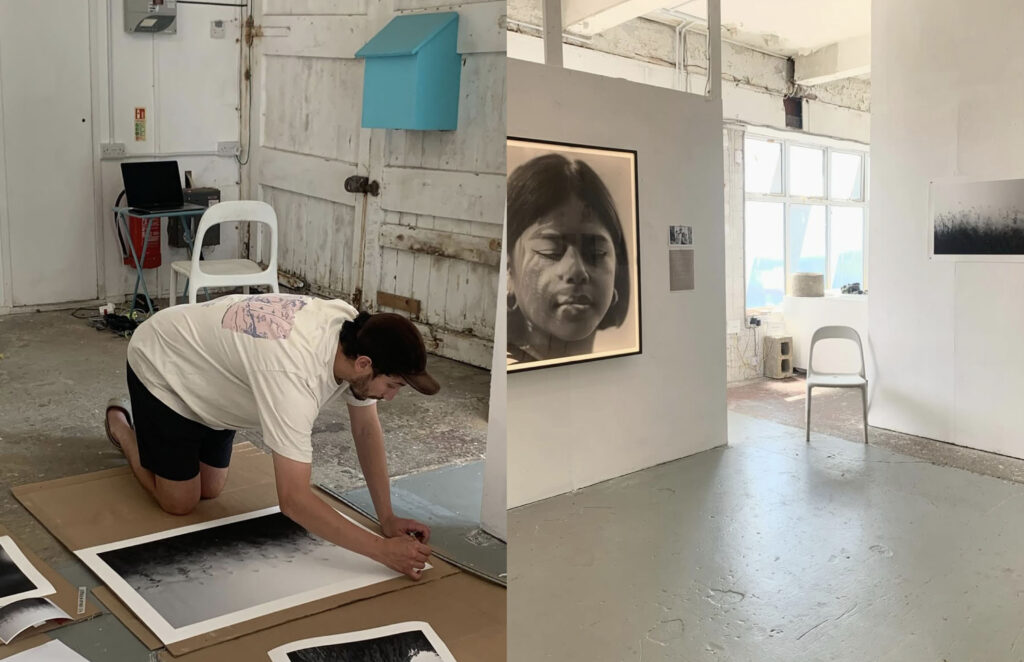
I’ll be honest, it was a shock to the system, but I loved it! I have never exhibited outside of my house, and this gallery had 3m tall walls. Practically speaking, I had two huge 1.7m light box frames, which my friend and I had reclaimed. He professionally installs shows, so I frantically got all the tips I could over those two days whilst sanding and staining the frames.
After that, I pretty much had some test prints up in the kitchen, a measuring tape at hand, and lots of head scratching. It was surprising how difficult and daunting I found the pre-visualisation. It’s more a case of not wanting to waste money on printing, or end up with lots of dead space. Needless to say, I spent the next two weeks learning about protective sprays and how to hang prints with magnets.
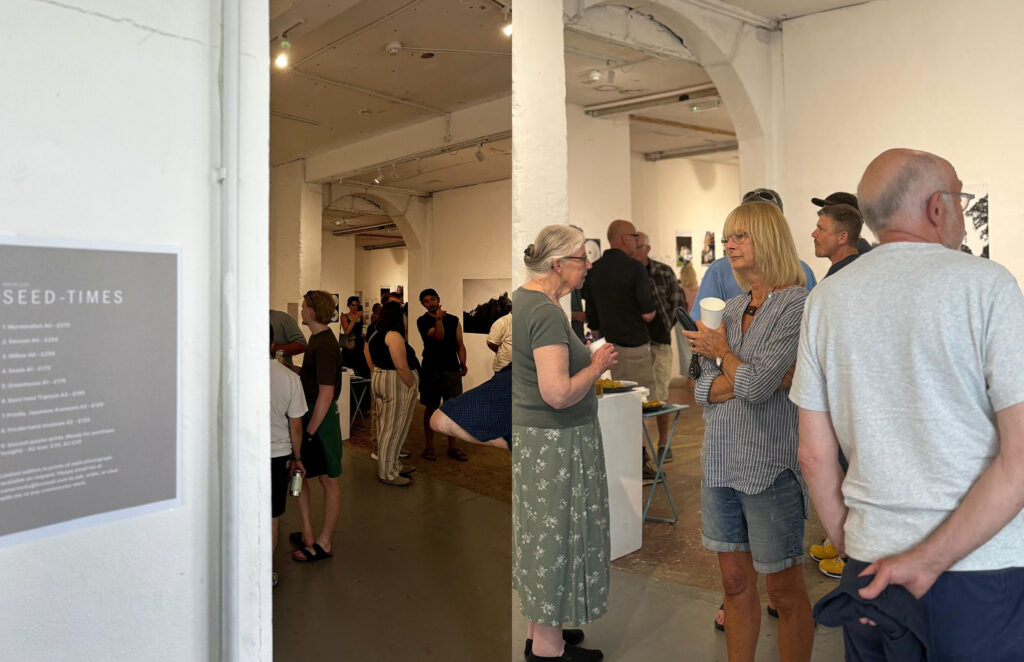
In terms of the event – I begged and borrowed from a local brewery and café to provide some drinks and snacks, as well as friends and family chipping in to make the opening night a great success. I had a few friends jump in and play some live music, which really made a difference. We were literally sticking up labels and hoovering the studio whilst the first wave of people came in.
I think one of my biggest lessons I learnt was not to take myself too seriously. The pressure is real, and it can suck the fun out if you let it. The day before the launch night, I felt rather stressed, running around trying to make it all look perfect, and my kids came to help, which really meant me tearing about trying to avoid prints being trodden on… but I realised I don’t actually like perfection in my work, and I was getting too serious. I changed tack, and we went to pick wildflowers for the gallery space. That was way more fun, and it looked all the better for it.
“Getting a grant was like getting permission to be me, and not hold back.”
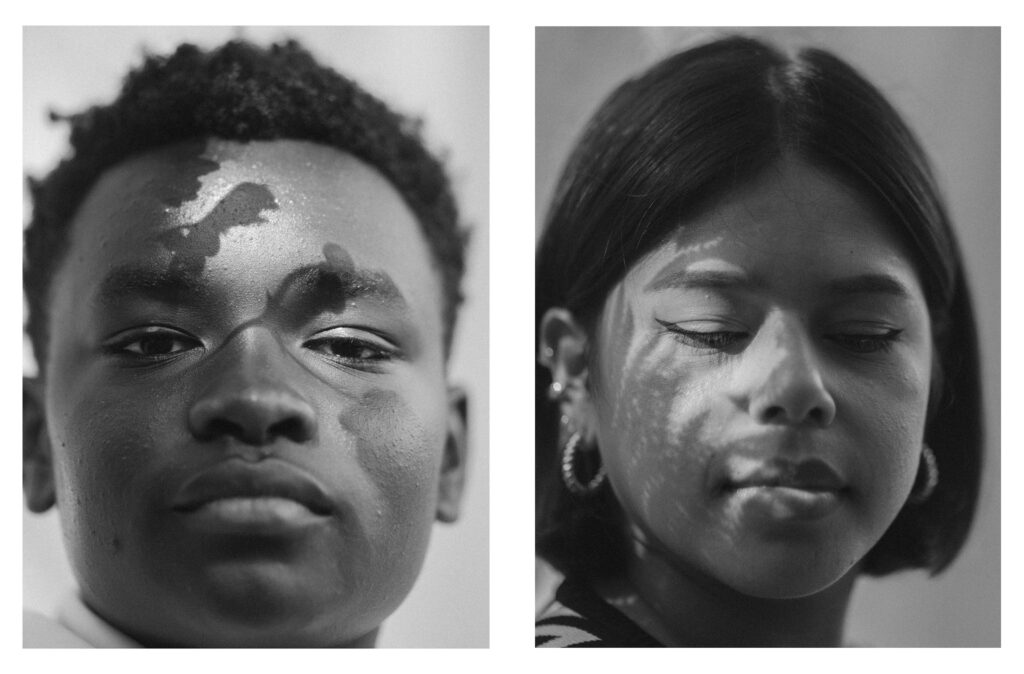
One of my favourite parts of the exhibition was that I’d got to collaborate with a poet. We’d made friends, and I’d taken his portrait, but then we started sending words and images back and forth, and this beautiful visual/verbal conversation took place. This again brought another level that I could not have done alone.
In terms of reactions and reception – I had some really fantastic conversations. Friends who’d been around and seen most of the work during the week were now in tears because the music and atmosphere had totally brought a different meaning to it all. Some people I’d photographed could come, which was amazing. One person in particular thanked me and said some of the portraits I’d taken had moved them deeply and that they felt they were a real celebration of an underrepresented part of Black culture. I was honoured to have met so many grateful and interested people.
What difference did it make to have a grant from Sputnik?
It honestly has been a massive confidence boost. I’d said at the start of last year that I’d love to do a solo show, as a sort of half-dream. Getting accepted was like getting permission to be me and not hold back.
It really was a great encouragement to give it a go, and express some ideas outside the church. Beyond making the project happen, the grant was the catalyst for me stepping outside my comfort zone and making some really meaningful connections.
At the same time I got the grant, another friend also wanted to donate to the project, and their wording has stuck with me since. They said that as they were praying that morning, they asked God who could they encourage beyond words, and that my name popped into their mind. I love that— and I think Sputnik shares the same heart— encouraging creatives beyond words.
We love that! And what happens next for ‘Seed Times’?
I have a few leads, but I’ll push some doors to see if publishing a photobook / zine will work out. My friend is always writing and I’m keen to keep the conversation going. Like I said, I usually have a few projects on the go, but to have a photo book of sorts with words and stories would feel like a really great resolution for this project. That’s the great thing about it, the more it expands, the more people I meet. Who knows what’s next?
You’re also a filmmaker. What are the biggest challenges facing that industry at the moment?
Mediocre content? Maybe that’s a bit harsh! We’re bombarded with content on a 24/7 basis, and it all looks good. The digital age has given us this amazing ability to capture beautiful images with these incredible cameras right in our pockets; but what about story, experience, intention? This maybe isn’t just related to film, kind of like how I mentioned limitations – anything is possible, but to make meaningful work I think you need to have a voice, and to do that you need to experience the world.
Terrence Malick [director of Thin Red Line, Tree of Life] once took a 10-year hiatus after directing the amazing Days of Heaven. Why? He said that he didn’t have anything meaningful to say. He wanted to go and live a bit more before coming back to directing. As a father with young kids, and as a pastor in a growing church – it’s so comforting to remember this. That living life is part of finding my voice, not separate or a distraction. These experiences become part of me and my work.
What would you want to tell people about the film industry that they might not realise, or would surprise them?
That the famous hand flowing through the fields of wheat in Gladiator is not Russell Crowe’s hand… it’s a stunt double, who just did it as they were walking to film a scene, and Ridley Scott made him do it again for the camera. As you can tell, I’m a nightmare to watch films with.
This one is hard, maybe I’ll share the saying – “A film is made three times – in the scriptwriting, in the filming and in the editing.” This is helpful to remember with anything creative, when you lose sight in the middle of a project and the end result feels a million miles away from the original concept. But I love filmmaking because it can be super collaborative; having other creatives bring their ideas to the table can usually mean things change for the better – as long as it still serves the main idea.
“To make meaningful work I think you need to have a voice, and to get that, you need to experience the world.”
Does being an artist give you a particular perspective on faith? What to artists bring to the church?
Being an artist and a Christian, I’d say, is the most amazingly natural thing. It’s my worship in so many ways. One thing I think artists can bring into the church is how we engage emotionally with God and the world. When I read the gospels and look at the life of Jesus, I see a man who didn’t shy away from the extravagant, impulsive, and somewhat culturally irregular acts of worship, like perfume being broken and poured out at His feet. I see a man who is able to harness spirit-fuelled creativity whilst keeping the law— bringing light into the world.
I think artists can sometimes feel unwelcome or not needed in church. We can start to disregard the abstract and odd, or throw out poetic licence for the sake of being clear, efficient and theologically sound. Don’t misunderstand me, artists really do need good theology, but people like C.S. Lewis were able to have one foot firmly in biblical literacy, and the other well and truly in the abstract, odd, and often unorthodox.
Do we sometimes look too quickly at being right, when the world is just as concerned about whether we really care, and who we really are? That’s why I believe God gave us art. Absolutely, we can reflect His glory, but also so that we can process some of life’s biggest questions, share complex feelings, speak out against injustice and unveil aspects of God’s character in ways that a Bible study or perfectly acceptable preach could never do.
This has been my story – artists and their art have unlocked something in me that has brought me closer to God. Rembrandt has in some ways helped me understand the Father’s love just as much as the Apostle Paul; [director] Jeff Nichols has helped me understand God’s tender Mercy as much as Mother Teresa. [Sculptor] Barbara Hepworth has led me to wonder at God’s handiwork in creation just as much as Wayne Grudem.
When it comes to being a follower of Jesus, I’ve never seen being inspired, theologically stretched, or emotionally engaged as a waste of time, and I wonder if artists are the people who can help us and our churches think, feel and live a little differently?
Find Caner at canermutu.com
Caner was speaking to Chris Donald (@chris.makes.things)


