
This interview is taken from MAKERS Zine #1 — get all future copies of MAKERS by signing up as a Patron today! You can also buy a copy of MAKERS #1 in our shop.
Laura K. Sayers is an illustrator and paper artist based in Glasgow.
Her work is meticulous and fascinating; it’s also fun, colourful, and bursting with life. Unsurprisingly, it’s gained her fans in all kinds of places.
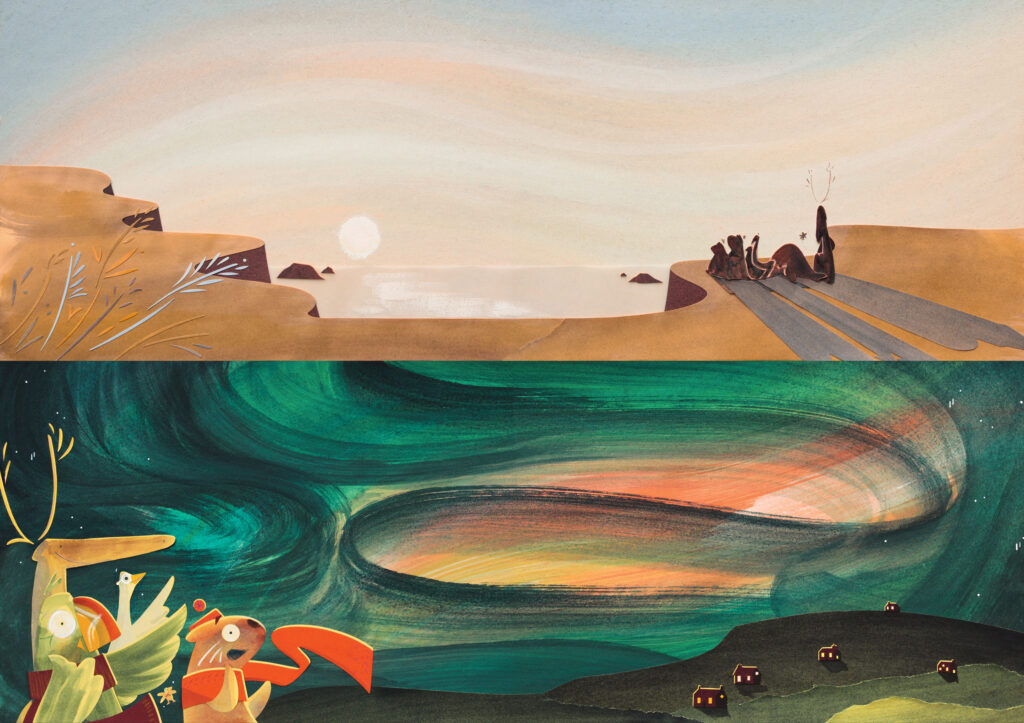
In early 2024, Sputnik gave Laura a grant towards a week-long residency on the Shetland islands, where she could sketch and research for a children’s book concept called The Simmer Dim. We caught up with Laura to talk about her art, her faith, and everything in between.
Hi, Laura. Firstly, can you tell me what you love about your work?
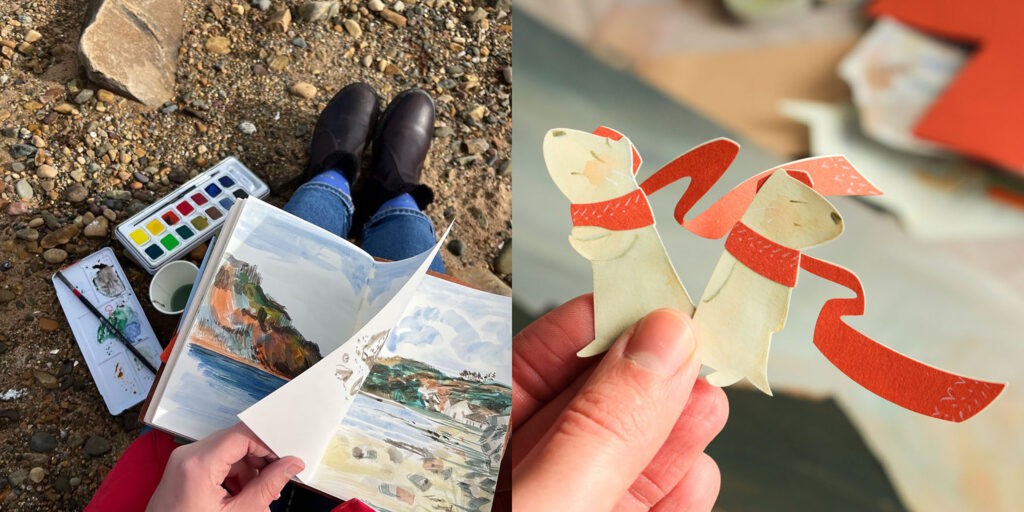
I love the tactility of the work — that’s what drew me to it. There’s always something special about working with your hands: I feel drawn to the physicality of building and holding a cut character, assembled from many layers of paper, each shape considered carefully.
I’m learning to appreciate the inaccuracies as well: small rips or folds in the paper. I used to really edit everything to try and be perfect, but it’s nice to see these things because you can see someone’s hand has been there.
I also enjoy the time it takes. Things in this day and age feel like they need to be instant; I’ve often been asked if I can speed things up — I’ve tried! But I’ve learned to embrace the time it takes, because I think it makes better results; and I like seeing how an image comes together in front of me. It takes a lot of patience, but I don’t think I’d want to do it another way.
How did the idea for ‘The Simmer Dim’ come about?
My friend happened to mention the fact that on Shetland, the longest time of the year is called the ‘Simmer Dim’, where the sun bobs down on the horizon and never really sets. The idea of the ‘simmering’ of the sun, the imagery that the phrase conjures up for me, really stuck with me.
I have a fascination with the changes of the seasons; it’s also something I find difficult — especially in Scotland, where the darkness of winter is really apparent, and we also get these really long days. The specific setting of Shetland became an opportunity to do something with that theme. I’ve seen a lot of work around the seasons, but this felt a bit more niche, something specific to explore and celebrate.
The Sputnik Patrons grant helped you to make a visit to Shetland. Was it what you expected?
I’d tried to make a few trips to Shetland and it hadn’t worked out. I was doing my best to look at it from afar, but I knew it was important to visit the place.
I found the people there so welcoming. They’re very proud of what they have, not in an English ‘patriotic’ way, but just open to sharing their way of life and their language. In terms of my expectations, I’d made a bunch of illustrations already, in the development of the book idea. I’d found one particular photograph of the side of a cliff — a very wiggly line with a sheer drop to it — and I’d embellished that photo, developed it as a motif in several images. I half wondered if this photo was just one tiny part of the island, and not representative of the whole island at all!
So I’d created these imaginary places — but it actually did look like that, and so it was fascinating to then see, in reality, things that I had in my head. Finding bits around the island that matched up with my imagined illustrations. And then looking closer, there was so much colour in there, and deeper layers of detail, which made it even more interesting.
How did the project develop as a result of that?
I think a lot about world-building in my work. Even though they’re just for children, these books, I’d like them to feel realised, and full. I don’t want them to feel like the scenes are empty or not believable.
A lot of scenes in this book are big landscapes, the book itself is long, and the landscapes are quite sparse. And Shetland is like that; there are lots of sparse landscapes and you can see for miles. But if you fill out that space with smaller details, hand written signs and very specific things that I saw, it makes it more lived-in. I’ve now got a wealth of information to add: it’s more the job of knowing how much to add and how much to hold back.
“It was fascinating to see, in reality, things that I had in my head.”
I think a lot about [graphic/prop designer] Annie Atkins, who puts huge detail into props that are hardly going to be seen; often in illustration you do a lot of background work that people probably won’t see, but it feeds into the bigger picture and makes it feel more whole. Sometimes people think of illustration in very simple terms, but I think there’s an opportunity to do something whole-hearted with it.
What difference did it make to have a grant from Sputnik?
In money terms, it was super helpful to have the funds to stay somewhere we wouldn’t have chosen otherwise; we ended up staying in a tiny converted church. I was looking for somewhere that was remote and unique — it was lovely to stay in, for one thing, but because of its history, the church is also still on all the old maps around the island. So I always felt aware of where I was, which makes me feel very rooted.
The encouragement from receiving the funding was such a big thing, to see that this project had something in it; somebody giving you that feedback and that affirmation. It’s quite rare, even to be given a small amount of money and just say ‘use it wisely, go and do something interesting’. It’s the first time I’ve ever done something like that, I’ve never done any sort of residency or travel for work itself.
Having a grant felt like permission to do my work, which is a real novelty. Especially with personal projects, things that are a labour of love, you can feel quite selfish doing those things: you’re not making money, you’re wasting time, you think there are more fruitful things you can be doing. But now I had permission to spend the time, and to observe, and take things in properly. It was the affirmation I needed to keep going with the project, and sometimes you need someone to step in and tell you to keep going.
“Having a grant felt like permission to do my work. It was the affirmation I needed to keep going.”
The project’s a little over a year old now, but actually painting the Aurora Borealis pages was quite a turning point for my work. I’d really been trying hard to introduce some painted elements into my collage, and that was the place it came together, which has since really fed into other things in my work. These painted elements are something I’m really enjoying, because it’s a space that can allow mistakes and happy accidents; things can be a bit more free and a bit unexpected. A combination of the planned and unplanned in my work is perfect.
What happens next for the book?
I have an agent who is taking this book, along with others, to publishers, to see what might happen. Whatever happens next, I’ve enjoyed the process of putting it together. I would love to go back to Shetland and do more with it.
I’ve had really good feedback on it, and there are a good few publishers out there doing interesting things, who might take it on, even if it needs to be developed a little. I hope so! The publishing world is very busy, it takes a lot to capture someone’s attention, but I’d like to eventually move into that world a lot more.
You have a very well-defined style, but you also describe it as laborious! How easy is it to maintain that uniqueness?
There’s a lot of copying in the art world; I’ve been copied a few times and it’s not a nice feeling. I wonder to myself how people deal with that inauthenticity. Of course I’ve sometimes made something that unintentionally looks really similar to something I’ve seen. It’s easy to do.
Practically, as much as I want to see what others are up to, I do think very carefully on what I take in. I try to look at more books, more old stuff, more exhibitions that are not in the same medium or even genre — taking in work and being inspired that way.
I’ve been working long enough on my own stuff that I can see the motifs and the things that are really important. I’ve taken the time to map out what it is that’s important in my work, the things that make it unique: even down to what kind of shapes do I like to use, the weight of a line; to hold onto those things and appreciate that those have come out of years of development, and have fed into my visual language and my voice.
I enjoy the limitations in my process, the constraints of a small thumbnail, or limiting my colours. The page is a constraint. Otherwise, you can so easily be distracted by the thought of all these other things you think you could be doing.
The themes of community and friendship come through very strongly in ‘The Simmer Dim’. How have your own communities impacted you?
I’ve been part of the Paper Artist Collective for 8 or 9 years. It was really a bit of a lifeline at first; it encouraged me so much to meet other people interested in the same things, working in the same medium, albeit in totally different ways. Everyone’s work was so unique; it encouraged me to really push the things in the medium that I loved and that were unique to me. The PAC exhibition, in London in 2015 or 16, was the first time I’d ever exhibited my work — the whole thing was quite makeshift, but I came away from it feeling like “I’m an artist now.” It was the affirmation of other people liking your work: these really successful artists having my work next to theirs.
“As much as I want to see what others are up to, I do think very carefully on what I take in.”
In terms of church, I’ve been at Harvest Church for 6 years or so since I moved back to Glasgow. There are a few creative people in the church, making incredible work. It’s great to be in a community with people like that, people whose work you really care about — but you’re there together on a Sunday to stop and to rest, to put work into perspective.
The church family really looks out for me in a lot of ways. They help me to break from work and reflect on other things. They can challenge me, too, if I’m taking on too much, saying “you don’t have to do that.” It’s not any guilt or shame, just good reminders that rest is important and time to stop is key.
Does being an artist give you a particular perspective on faith?
I’m hugely inspired by creation and the beauty of the world. I’m not avoiding the ugly side of the world — but I think there’s merit in celebrating the things that are beautiful, and not man-made. Art and design is an amazing way to enhance what we have, to use the materials that we’ve been given to make new and beautiful things.
I think that feeds back into my faith: that even getting to do this work itself feels like a blessing. For one thing, I have really big hands! I’m a really clumsy person usually, but I can sit down and make these very intricate pieces of work. When it works out, it’s almost a magic moment. I know it’s also down to practice, and the time I’ve put in, but in lots of ways it feels like God working through it. I find it helpful not to wholly rely on my own skills and plans.
It’s helpful to have a faith to see things from a bigger perspective, to take a step back from work. I do take things very seriously; my work can seem all-consuming because I pour so much of myself into it. It’s there to inspire people, it’s good to bring something new into the world, but I also have to remember these are just small offerings. That actually encourages me to try my best, to make work that I’m proud of and care about, work that feels whole-hearted. I’ve become less ambitious in a way: in the past, I wanted to succeed and get somewhere. Now — certainly I’m in a more comfortable spot, but I also feel more relaxed about whatever comes next.
Find Laura at lauraksayers.com
Laura was speaking to Sputnik’s Art Director, Chris Donald (@chris.makes.things)


